About this site
You know how sometimes you find yourself on a dog sled and end up driving?
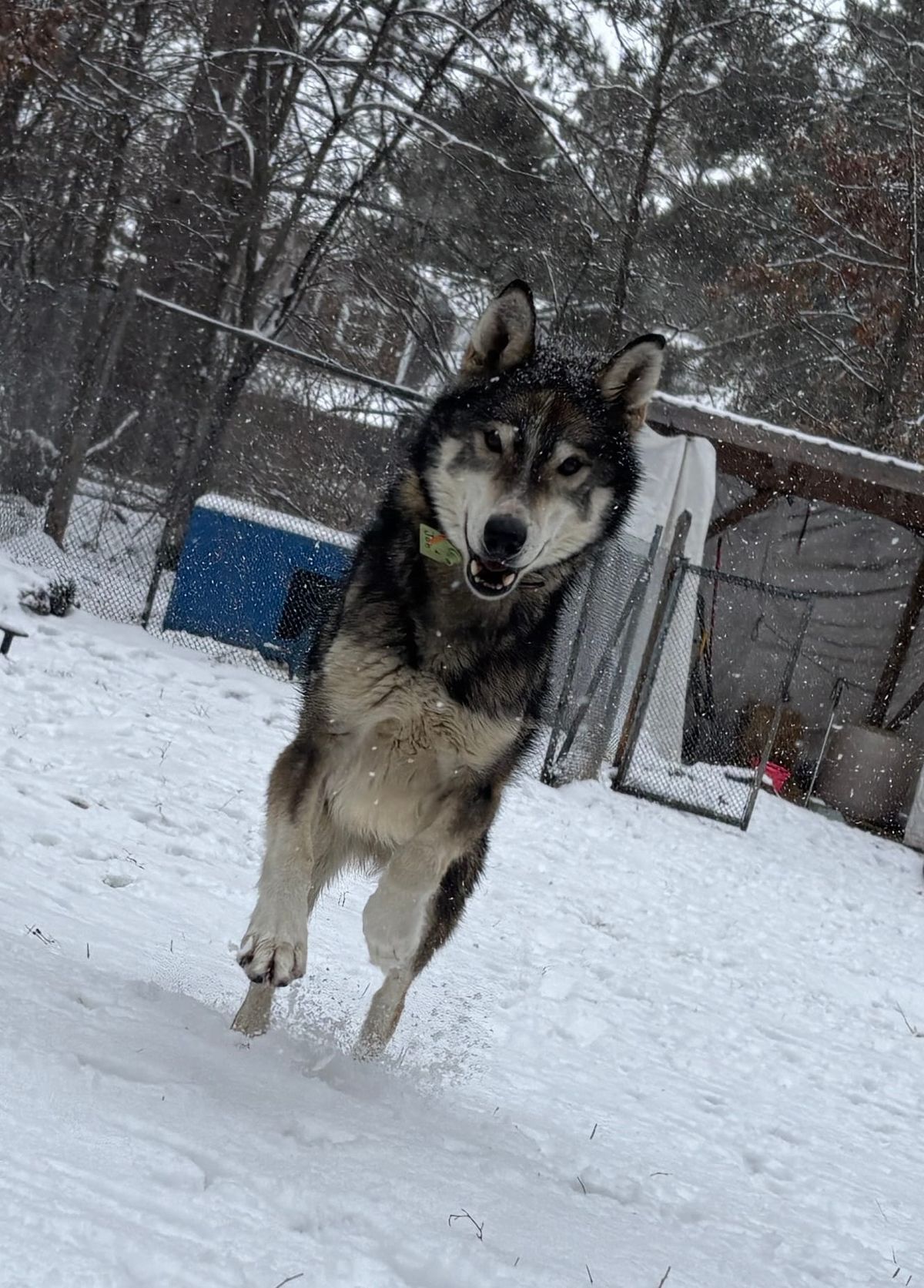
You know how sometimes you find yourself on a dog sled and end up driving?
Our guide said all the musher is responsible for is control - balance and pace. The dogs are going to run. And run. And run. If you stop, they will howl until you let them run again.
They will run. And then they will run some more.
Because of that, the musher’s foremost rule is to keep a hand on that sled at all times or risk it running away on you. Also, she said, if you don’t put a little pressure on the brake to slow them down once in a while they will eat up ground faster and faster until they’ve completely exhausted themselves or driven you off a cliff[^1].
Oh, and at the same time, if you don’t keep your balance on the skids, shifting to the right or left to keep things steady, depending on the turn you’re taking? Yeah. You, the sled, and everyone and everything in it will tip over. Most likely at top speed.
It turns out democracy - and our democratic institutions - are a lot like that sled. There are forces out there constantly looking to attach to them in an effort to corrupt. Without citizen mushers in place to maintain control, those forces will run our democracy into a snowbank.
Because for democracy to thrive, it doesn’t require belief. It requires vigilance[^2].
To that end, The Muckraker does not exist to offer ideology. It exists to offer control - a hand on the sled and a foot on the brake.
The Muckraker documents how power actually works, not how it is described or marketed. We assumes institutions fail quietly and that individual incentives often defeat institutional intention. Our obligation is to accuracy, context, and the intelligence brought by you, friends, and not to outcomes, partisanship, or virality. We aim to leave a reliable record that helps people understand their government as it was designed, as it could have functioned, and as it really works. Then, to give them the tools to do something about it. We hope to do all of that while not pretending to be neutral about democracy, the rule of law, or human dignity.
Local newsrooms - for actual newspapers, when those were a thing - used to be the backbone of our democracy. Radio, television, and, eventually, Internet newsrooms all relied largely on the dogged investigative work of print reporters, the folks in the communities willing to sit through meetings of local government and let everyone else know what was going on. If newspaper editors were the tastemakers of a community, newspaper reporters were its watchdogs. But over the past 25 years, those watchdogs have been let go, replaced largely with corporate and government press releases designed to get the official line out there without anyone to vet it and to ask probing questions.
I wanted to go on a nice long rant here about why this matters, but I can’t say it better than Robert W. McChesney and John Nichols did in their book, “The Death and Life of American Journalism”:
“A world without journalism is not a world without political information. Instead it is a world where what passes for news is largely spin and self-interested propaganda–some astonishingly sophisticated and some bellicose, but the lion’s share of dubious value. It is an environment that spawns cynicism, ignorance, demoralization, and apathy. The only ‘winners’ are those that benefit from a quiescent and malleable people who will ‘be governed,” rather than govern themselves.” – The Death and Life of American Journalism, preface, page xxxviii
I walked out of a local newsroom for the last time in December of 2005. I wasn’t alone. According to McChesney and Nichols, the second quarter of 2009 saw an almost 30% drop in newspaper revenues from a year earlier. It was the largest quarterly drop since the Great Depression, and, though it was the 12th straight quarterly revenue decline since 2006[^3], it was also only the beginning.
The decline of American journalism will be our first deep dive, but for now, it is sufficient to note that almost 3,500 newspapers have disappeared from the face of the earth since 2000[^4]. A 2020 report[^5] by S. Derek Turner at freepress.net noted that by that time the newspaper industry had lost 55% of its reporting jobs and 65% of its overall jobs since a peak in 2005[^6].
And what has emerged in place of those jobs? Modern media has become a system fueled by adrenaline and dopamine, optimized to create division, outrage, and short attention spans. But I believe there is still a place for slow, civic journalism that can empower people. Thoughtful work created for an audience leery of corporate media and looking for a place where they can gain an understanding of an increasingly complex American democracy without agenda, hot takes, and equivocation. I still think that kind of thing can break through the noise, and I’d like The Muckraker to be a place that can add to and amplify those voices.
So at The Muckraker, you will find no hot takes, no appeals to rage or mistrust, no corporations, no parties, and no bullshit. Just civically curious people who want to understand how the government actually works and where the corruptible gaps exist between theory and reality. That's tough to find in corporate or social media anymore, but it’s a lane that needs to be filled if we want this experiment of our founders to continue. We’ve reached a moment where perhaps only independent media can do that.
We want The Muckraker to be one small link in that chain. There are many good independent media outlets out there doing on-the-ground reporting, and we will always do our best to spotlight and amplify their work, but we are not one of them. Our goal is to supplement the important work being done by those outlets with detailed, forensic looks at how our government was designed, how it could work, and how it works in real life.
In that regard, The Muckraker is not a news site, exactly, and it’s more than a newsletter. It’s an audit of power, from source to execution. It’s a forensic library. It’s a civic digest and infrastructure lab, where we try to translate the chaotic reality of governance into a useful and lasting map.
And in doing all of that, sometimes it’s about dog sleds and things.
We’re not interested in partisan noise or achieving specific outcomes. In those areas, we stay neutral. But we are not neutral about democracy, accuracy, context, or truth. We think that to be vigilant about our Constitution - indeed, our self-governance - is first to understand how it was designed, what it could be, and what it really is.
We want to be a place where the tools exist for any citizen to put a hand on the sled, a foot on the brake, and assert control over their democracy.
Welcome to The Muckraker.
**
Footnotes
[^1]:It’s one foot on the brake to slow them, and two feet with all your weight to stop them, which might also be a decent editorial credo around here.
[^2]:Listen, here’s the secret: This is basically the entire argument for this publication to exist in 12 words, but don’t tell anyone that or we will end up a very short and dry publication.
[^3]:This is taken from Chapter 1 of the McChesney/Nichols book, citing a September 1, 2009 report by Erik Sass
[^4]:Medill
[^5]:FreePress.net, “How Big is the Reporting Gap?”
[^6]:I’ve grown increasingly frustrated and deeply dissatisfied with the modern media infrastructure that has emerged to replace those jobs. Corporate mergers and acquisitions have left old, trusted media sources feeling, and honestly, probably operating, like agenda-driven corporate platforms. Meanwhile, social media discourse tends toward being shallow, performative, and algorithmically driven to keep us siloed off from one another. Believe me, we will talk A LOT more about that shit as we go.